
Enterprise-grade access control. At mid-market HOA prices.
Mobile credentials have collapsed the cost of the same access-control platform that used to be exclusive to corporate campuses and hospitals. A 202-unit master-planned community used that shift to replace aging standalone keypad locks and clamshell prox cards with cloud-managed Brivo Access.
One card per household became one credential per person. 429 credentialed admits in the first month, every one tied to a named user — and a first-ever look at how the pool, spa, and tennis courts actually get used. The data is a bonus. The real story is that this class of system is now within reach for a mid-market HOA at all.
Mobile credentials rewrote the math for mid-market HOAs.
Enterprise access control existed — corporate campuses ran it for decades — but the per-reader hardware, per-card manufacturing, and vendor-programmed enrollment made the total cost land far above what an HOA reserve budget could absorb. So mid-market HOAs stayed on standalone keypads while Fortune-500 tenants ran real access control down the road.
A mobile credential costs a fraction of a physical card, needs no vendor to program, and gets issued from a browser in seconds. That single shift collapsed the ongoing cost of real access control — and put the same platform hospitals and corporate campuses use inside reach for a 202-unit community's reserve budget.
Aging standalone keypad locks at every amenity opening, backed by clamshell prox cards issued roughly one per unit. Most people actually used a shared cheat code on the keypad. Programming a card meant a $250 vendor trip. Lock replacements averaged $2,500. Audits required a technician on-site walking each lock with a patch tool.
Cloud-managed Brivo Access across seven openings on two sites. One credential per person instead of one card per household. Every admit named at the source. The utilization data the board now reviews monthly wasn't the reason for the project — it's a byproduct of the platform they can finally afford.
Same gate. Modern hardware. Very different accountability.
Every pool and tennis opening was running a standalone keypad lock backed by clamshell prox cards — and a shared cheat code that most residents, staff, and vendors used to bypass the cards entirely. Replacing the hardware was the visible change. Putting every opening on a cloud dashboard, tied to named mobile credentials, is where the real accountability comes from.
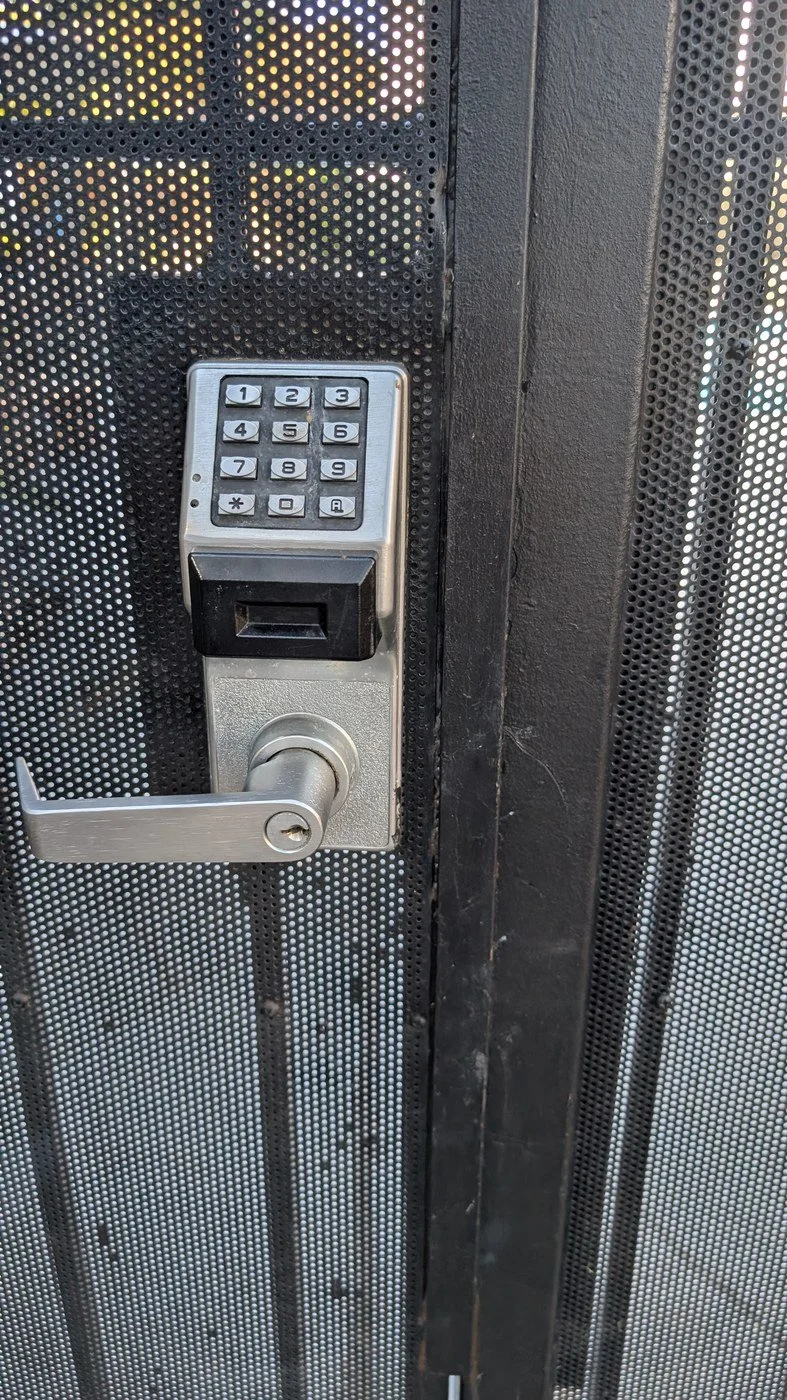
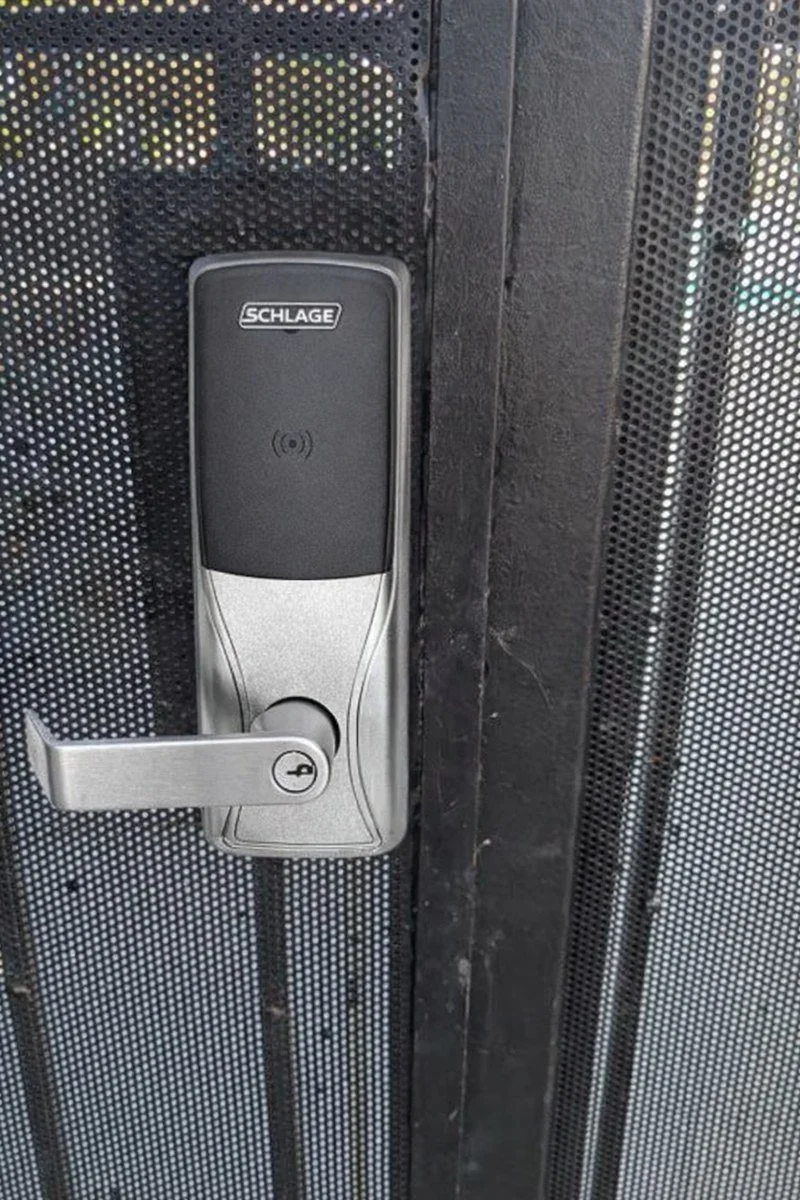
One Brivo Access account. Two sites. Every opening on the same dashboard.
Clubhouse & Pool Complex
The primary Brivo control panel lives in the mechanical room near the pool. From there, wireless electronic locks and multi-technology readers control every access point in the community's main amenity building.
- Pool Main Gate + Pool Back Gate
- Pool Door to Bathrooms & Clubhouse
- Clubhouse Interior Door
- Clubhouse Front Door
- HOA Office Front Door (2nd story)
Tennis Courts & Storage Area
A satellite Brivo controller with cellular connectivity handles the tennis courts and maintenance area — even though the outbuilding has no HVAC or wired network. Same cloud account, same dashboard.
- Tennis Court Gate 1
- Tennis Court Gate 2
- Maintenance / Storage Gate
One dashboard. Every event. Named credentials.
The board and community manager both log in to the same Brivo Facility Manager dashboard from any browser. Real-time event tracking, credential provisioning, schedule management, and door status all live in a single view — no on-site trips, no local software, no vendor calls to add a resident.
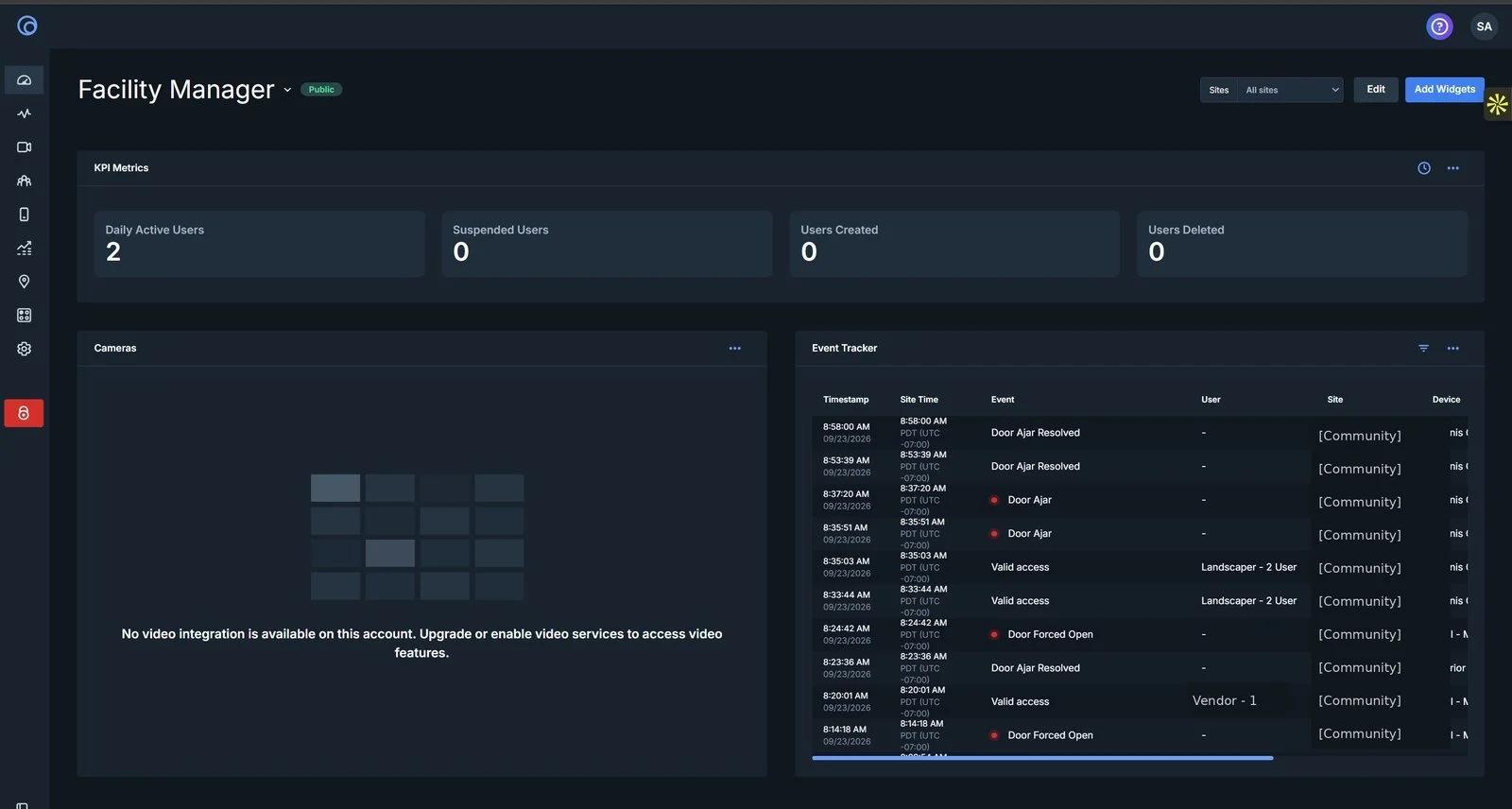
Live Brivo Facility Manager dashboard. Site identifiers redacted for this case study; all other events, users, and doors are real.
Real-time event tracker
Every valid access, door-ajar, and door-forced-open event streams live. The board sees exactly who accessed what, when, and where.
Instant provisioning
Add a new resident's credential from any phone. Deactivate a departed tenant's access in seconds — no rekeying, no code changes.
Scheduled amenity hours
Pool and courts enforce their posted hours automatically. Board or manager can grant one-off access for events without permanent exceptions.
Governing by data instead of anecdote.
Under the old system, this data existed only in fragments on each individual lock — pullable with a technician's patch tool, then correlated by hand against a card-assignment spreadsheet. Now every credentialed entry, every door, every hour lands in one place, tied to a named person the moment it happens.
Credentialed entries across all seven amenity openings in the first month of live use.
Share of all amenity admits going to the pool and spa — more than twice the tennis use.
Distinct pool users on credentialed access — the board's first-ever count of active pool users.
Every admit fell between 7 a.m. and 10 p.m. — schedule enforcement working as designed.
What the board now knows
- Pool Main Gate is the busiest entry — 204 admits, nearly half of all amenity use
- Pool use is spread across the day from 8 a.m. to 8 p.m.
- Tennis use clusters at 8 a.m. and 5 p.m.
- Labor Day was the single busiest day, with 36 pool admits
- The pool sees more than twice the demand of tennis — informing amenity budget and staffing decisions
Why that matters
For the first time, the board can defend amenity budget allocations, staffing decisions, and rules-enforcement conversations with data instead of anecdote. A resident complaint about pool crowding can be checked against the actual data. A proposal for extended hours can be evaluated against real use patterns. A vendor claim of "scheduled visit" can be verified.
See the full utilization report. A 1-page PDF summarizing the first month of amenity use — the same report the board reviewed.
Download the ReportAmenity access isn't a security question. It's a resident-value question.
Residents pay assessments for amenities whether they use them or not. Rationing access at one card per household kept usage down and made the pool, spa, and tennis courts feel like a shared inconvenience rather than a shared benefit. Moving to one credential per person changes the math — with downstream effects the board, the manager, and every landlord owner feel.
Owner-Resident Retention
When residents get real use out of the amenities they pay for, satisfaction with the board and manager climbs and the pull to sell or convert to a rental weakens. Amenity friction is a quiet driver of owner-to-landlord churn — and the drift from owner-occupied to rental changes the character of an HOA over time.
Rental Economics
Landlord owners can market and price against a functional, credentialed amenity package — which is easier to justify at a premium than "there's a pool somewhere and a code that might work." Tenants get their own credentials without a vendor visit, and turnover cycles no longer cost the owner a $250 card-swap trip charge.
Safer, Better-Maintained Spaces
More residents actually in the amenities means more informal, natural security — the eyes-on-the-space effect that no camera fully replaces. And equipment that gets exercised regularly (pool pumps, gate motors, tennis-court surfaces, door hardware) stays in better working order than equipment left idle for months at a time.
The old system was defended as a security measure. In practice, it kept residents out of the amenities they paid for while a shared cheat code did the actual work — and produced no audit trail.
Consultation to commissioning to ongoing service.
Every Prosiren engagement follows the same shape. Boards see the whole path before signing anything. Managers know exactly what happens in what order. The community got the same treatment — no surprises, no scope creep.
Initial call with the board president or manager to understand pain points and constraints. No obligation.
On-site walk of every amenity opening with the manager. Photograph existing hardware, map network and power availability.
Match the community's governance and rules to a system design. Identify what stays, what upgrades, what phases can wait.
Live walk-through of the recommendation with the full board. Marketing materials for the residents provided on request.
Order-of-magnitude cost sized for reserve-fund planning. Board can start budget conversations before final proposal.
Board-packet-ready proposal with detailed scope, exhibits, installation plan, and separate one-time / subscription pricing.
Licensed low-voltage installation, phased to minimize amenity disruption. Full system commissioning and administrator training.
Cloud subscription with credential-management support, monthly utilization reports, and a direct line to the specialist who designed the system.
Accountability. Access. Governance. All measurable.
-
One Credential Per Person
The old prox-card system rationed access at roughly one card per household. Now every household member — spouses, adult children, long-term guests, tenants — gets their own mobile credential. Broader access for the people who actually pay for the amenities, and every admit named at the source. 48 unique pool users and 22 unique tennis users in month one, without a single vendor trip charge to issue any of them.
-
Real Accountability
All 429 admits in month one are tied to a named credential. Before Prosiren, most amenity use ran through a shared cheat code on the keypad — an audit blind spot for the majority of entries. Now, when an incident happens at 8 p.m. on a Tuesday, the board pulls an event log for that window and sees exactly which residents used their credential at each gate. Every admit still fell between 7 a.m. and 10 p.m., enforced automatically by the schedule.
-
No More Trip Charges
Adding a new resident's credential now takes 30 seconds from any browser. Deactivating a departed tenant is instant. Under the old system, that meant a $250 vendor trip charge and a scheduling wait — or a $2,500 lock replacement when a prox reader gave out. The board and manager now do it themselves, no service call, no downtime.
-
Audit in Two Clicks
What used to require a technician on-site, a patch cable at each lock, raw data files kludged together, and a card-assignment spreadsheet cross-reference now takes two clicks in a browser. Every admit is named at the source — no correlation, no spreadsheet, no guessing whether the cardholder was actually the person who used the card.
-
Utilization Data, First Ever
The board's first-ever amenity utilization report shows the pool sees 69% of amenity use, peaks between 4 and 6 p.m. on weekdays, and drew 36 admits on Labor Day. Data the board uses for staffing, budget, and rules enforcement — delivered monthly as a standard service deliverable, not a technician's on-site special request.
Want the same outcome for your community?
Every Prosiren engagement starts with a free on-site walk-through and a board-ready proposal within two weeks. Same process this community used.
Download the full PDF case studySame story, includes the 1-page utilization report — formatted for board-packet inclusion.
Download PDF